 Grandma's Recipes
  京都府
京都府 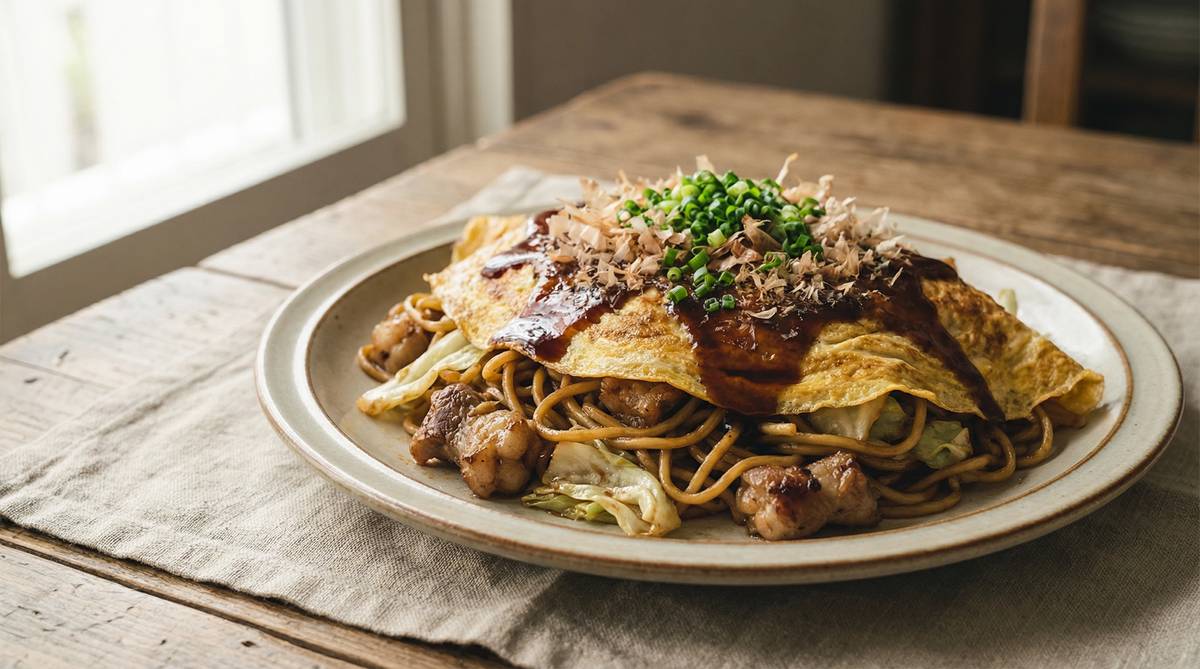 * Photo is for reference
 和歌山県 🌻 Summer
Japanese Grandma's Offal Omu-Soba (Horumon Omu-Soba)
This bold, satisfying dish from Wakayama combines yakisoba noodles with flavorful offal (horumon), wrapped in a thin egg layer and topped with bonito flakes. Grandma invented this budget-friendly lunch to keep her hungry grandson full during summer vacation, using three whole packs of noodles for a single serving.
🧂 Ingredients
servings
* In traditional Japanese grandma cooking, measurements are approximate — think of them as guidelines rather than exact amounts.
| Main Ingredients | |
| Yakisoba noodles | three packs |
| Cabbage | a bit |
| Horumon (beef or pork offal) | a bit |
| Egg | one |
| Seasonings | |
| Sauce (blend of yakisoba sauce and Worcestershire sauce) | lots (About 60g yakisoba sauce + 40g Worcestershire sauce) |
| Katsuobushi (bonito flakes) | two big pinches |
👩🍳 Instructions
- 1
Heat oil in a frying pan and stir-fry the horumon.
- 2
Once the horumon is partially cooked, add shredded cabbage.
- 3
When the cabbage is tender, push the cooked ingredients to one side and add the yakisoba noodles to the empty space.
- 4
Carefully push the stir-fried ingredients on top of the noodles and heat for about 2 minutes.
- 5
After 2 minutes, flip the whole thing over using the pan.
- 6
If the noodles have nice char marks, add the sauce mixture and toss to combine.
- 7
Push the noodles to one side, add a little oil to the empty space, and crack an egg onto it.
- 8
Lightly break the yolk, then slide the noodles on top of the egg.
- 9
Cook for about 45 seconds, then flip the whole thing over.
- 10
Plate on a large dish and top with bonito flakes.
📖 Memories & Stories
Grandma's house was a small shack, so the kitchen was right next to the table, and I could watch exactly how she cooked. That's how I remember the recipe. She seemed to struggle with what to make for my lunch during summer break. Using three packs of noodles for one person tells you how much I ate as a kid. This was grandma's invention to satisfy my stomach while keeping costs down. Back then her house had no air conditioning, and she'd be sweating while making the yakisoba. Knowing how hard she worked for me, I felt I needed to do my best for her sake. Every summer break lunch was grandma's yakisoba.
Source: Written from memoryOther (Submitted by: 次郎)
🍽 Cultural Background
Horumon (offal) gets its name possibly from 'horu-mon' meaning 'things to throw away,' and became widespread during the post-war food shortage era. The Kansai region, including Wakayama, has a deeply rooted horumon food culture, and adding it to yakisoba or udon on a flat griddle is a quintessential Kansai-style dish.